How Consolidating Global Sourcing Improves Manufacturing Reliability
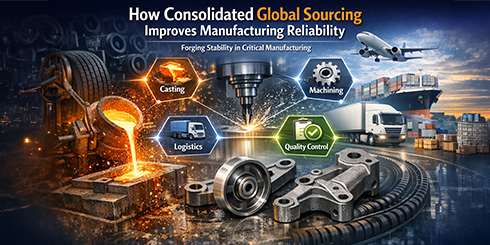
- Casting, machining, logistics, and quality unified under one framework
- Reduced scheduling variability and rework
- Consistent dimensional performance across three materials
Long-standing supplier relationships are built on trust. For years, RJS Corporation relied on a stable sourcing structure to support the components inside its tension controllers. RJS designs and manufactures spooler equipment used by tire manufacturers in radial tire production — production-critical environments that require precise wire handling and tension control.
But manufacturing environments evolve. Lead times tighten. Capacity shifts. As volumes increased and schedules became less forgiving, RJS recognized the need to strengthen its supply structure — not because of failure, but because expectations had changed.
Why fragmentation quietly builds inconsistency
A single late shipment rarely derails a program. The real impact shows up when each stage of production operates in isolation: casting sourced one way, machining handled somewhere else, logistics tracked separately, quality documentation managed through its own channel.
For RJS, fragmentation had meaningful implications. The wheel, arm, and support assemblies directly affect dimensional performance inside the tensioner system. When precision shifts or delivery cadence becomes uneven, issues show up in scheduling, assembly sequencing, and customer commitments.
MES simplified the model. Instead of juggling separate suppliers for casting, machining, logistics, and quality, everything ran through one coordinated system.
Coordinating casting and machining as one process
The wheel, arm, and support assemblies are produced across iron, aluminum, and cast steel. Each material behaves differently during solidification, cooling, and machining — variations that influence how tolerances hold over time, especially under load.
Rather than treating casting and machining as separate handoffs, MES evaluated the production flow as a continuous process:
- Selecting foundries based on machining performance, not casting alone
- Identifying critical features early in the process flow
- Placing dimensional checkpoints before and after machining operations
Structured quality control that scales
Each component family was managed as a controlled program with aligned drawings, revision levels, and inspection criteria established before production expanded. Critical dimensions tied to fit and function were identified early and verified at structured checkpoints throughout the process.
Material certifications, inspection reports, and process documentation were organized to give RJS clear visibility into how parts were produced and validated — supporting faster decision making and more confident production planning.
Consolidated sourcing isn’t about fewer suppliers — it’s about clear ownership of the entire flow. If your components pass through too many disconnected hands, we should talk.
Start the Conversation