Acuity Brands: 12 Weeks of Inventory Eliminated
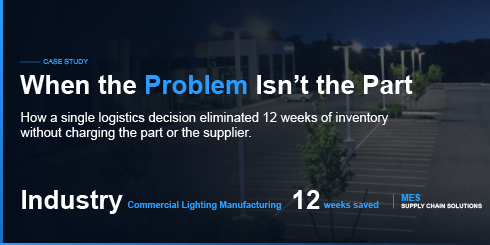
- 12 weeks of inventory eliminated
- Freight costs reduced without renegotiating unit pricing
- Same part, same supplier — zero requalification risk
Here’s a scenario most manufacturing teams know all too well: a component is performing exactly as designed. The supplier is qualified, the tooling is dialed in, and quality is consistent. Nothing is broken.
And yet, the supply chain around that part is adding cost and burning time through fragmented shipments, excess inventory, and the steady organizational tax of coordinating too many moving pieces.
Acuity Brands — one of North America’s largest commercial lighting manufacturers, with brands including Lithonia Lighting — came to MES with a supply chain problem that didn’t show up in any quality report.
A component that wasn’t the problem
The part in question was a molded plastic lens for parking garage luminaires. In commercial parking structures, these lenses aren’t decorative — they shape how light is distributed, control glare, and improve visibility for drivers and pedestrians.
The lens was being produced by an established Taiwanese supplier with proven tooling and stable processes. There were no quality issues and no delivery failures. But Acuity had limited operational infrastructure in Taiwan, and the gaps never showed up as formal complaints. They just made everything harder.
The hidden cost of fragmented logistics
Parts were moving less-than-container-load (LCL) — the default when you don’t have enough volume to fill a container or the coordination infrastructure to consolidate. LCL works, but it carries a cost premium, less predictable transit times, and a compounding coordination burden.
To compensate, Acuity was carrying more inventory than demand required. The buffer protected against variance, but it tied up working capital without solving the issue. Internally, engineering and operations staff were spending meaningful time managing shipment logistics rather than improving their processes.
None of this would show up on a supplier scorecard. The challenge was structural, not sourcing.
The question that changed the approach
The instinctive response to supply chain friction is to look for a new supplier: rebid the part, move production, start over. MES asked a different question — what if the supplier isn’t the problem?
Replacing a qualified supplier with an established process introduces real risk: requalification time, tooling costs, and production uncertainty during transition. None of that addresses the underlying logistics structure. Instead, MES took over the logistics layer around the component — ordering coordination, shipment planning, warehousing, and integration with the broader supply chain.
The lever: consolidation into an existing flow
MES was already managing die-cast components for Acuity through an established logistics operation in China. The Taiwan-sourced plastic lenses could be integrated into that existing container flow rather than moving independently on their own irregular schedule.
That single structural change produced a cascade of improvements:
- Shipments became predictable
- Freight costs dropped without any renegotiation of unit pricing
- Inventory exposure dropped by 12 weeks
- Supplier coordination was simplified
Sometimes the right solution has nothing to do with the part itself. If your supply chain is carrying cost that never shows up on a supplier scorecard, let’s talk about the structure around your components.
Start the Conversation