Securing Supply for a Critical Medical Lift Component
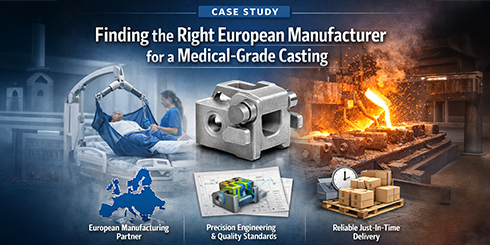
- European investment casting supplier identified and qualified
- Full assembly, retention-force testing, and compliant delivery
- Delivery reliability restored for a patient-safety-critical part
There’s a small steel component, just a few inches across and weighing less than 200 grams, that connects a mobile patient lift to the sling or stretcher that cradles a person who can’t move on their own.
It doesn’t appear in any product brochure. But when a caregiver wheels a lift to a hospital bed and clicks the patient’s lifting accessory into place, that component is bearing the full weight of a human being.
Baxter International, through its Hill-Rom brand, is one of the world’s leading manufacturers of patient handling equipment. For years, the company sourced this component from China. Then the pandemic hit, and deliveries to Baxter’s production plant in Luleå, Sweden started slipping. For a company whose products are used in direct patient care, “late” simply isn’t acceptable.
Finding the right European manufacturer
MES identified a precision investment casting foundry in Central Europe with decades of experience producing complex steel components for aerospace, defense, automotive, and food processing — supported by ISO 9001, ISO 14001, and ISO 50001 certifications.
Capability alone wasn’t enough. The component — Baxter’s Q-Link Mobile Lift Quick Connection Frame — needed to be cast and machined, but also fully assembled, tested, and delivered as a finished, compliant unit, including retention force testing verifying that the connection mechanism holds under load before a single unit left the facility.
Baxter sent a team to audit the plant in person, covering manufacturing capability, quality systems, traceability, and supply chain processes. The supplier passed, and the project moved into engineering development.
Engineering collaboration, not just supplier management
Rather than acting as an intermediary passing messages, MES brought the manufacturer directly into technical conversations with the end customer. From the earliest stages, all three parties were in sync.
The Q-Link is produced via investment casting — lost-wax casting — which allows complex geometries and tight tolerances other casting methods struggle to achieve. Achieving consistent results required flow simulation analysis to model how molten steel fills the ceramic mold, and iterative engineering discussions on process parameters balancing structural integrity and surface quality.
Surface quality mattered more than it sounds: the Q-Link is visible, seen and handled by clinical staff every time a patient is lifted. Baxter had specific requirements for the color and texture of the finished surface after shot blasting.
The outcome
A fully qualified European source now produces, assembles, and tests the component to medical-grade standards — with delivery reliability restored for a part where failure is not an option.
When a component carries patient safety on its shoulders, supply continuity is a design requirement. If you need to qualify a new source for a critical part, MES has done it — on two continents.
Start the Conversation