How GCX Strengthened Supply Stability for Precision Medical Stampings
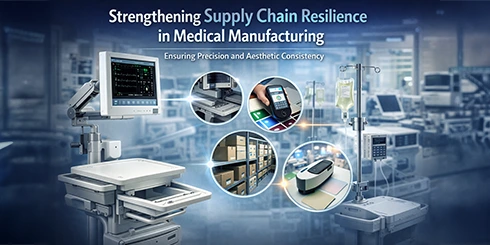
- Second production source qualified with no visible difference
- Measurable color and finish consistency across 30+ approved coatings
- Dimensional stack-up issue diagnosed and resolved at the weld level
The most stable manufacturing operations don’t wait for disruption to force change. They strengthen what works and build flexibility before it becomes urgent.
GCX designs and manufactures mounting systems and medical carts used in hospitals worldwide — equipment supporting monitors, IV systems, and other critical devices where durability, precision, and appearance are essential.
For more than two decades, key stamped sheet metal components were sourced from a single supplier in Taiwan. The relationship was dependable, but GCX chose to diversify its production base — preserving dimensional precision and visual consistency while adding geographic balance.
Matching legacy production without visible difference
Transitioning stamped components to a new source requires far more than duplicating a drawing. The parts in scope — trays and structural brackets integrated into hospital equipment — were press-formed, bent to controlled radii, welded, and powder coated to strict aesthetic standards.
Because these parts are visible in clinical settings, variation is not simply cosmetic. Several technical realities shaped the project:
- Tight dimensional tolerances across formed and welded features
- Controlled bend radii influencing final assembly fit
- Weld placement influencing overall geometry
- Powder coat finishes across more than 30 approved colors with measurable color values and gloss targets
Translating experience into repeatable controls
Early samples revealed how much practical knowledge had accumulated over years of production. Some specifications were documented; others lived in experience. MES worked closely with GCX to translate years of accumulated understanding into defined, repeatable production controls.
The goal was clear: when a tray or bracket left the line, it needed to integrate seamlessly. No shade variation. No visible weld distraction. No dimensional drift affecting fit.
Solving a weld that shifted the entire assembly
During early production runs, a dimensional issue surfaced within a five-part assembly group. Individually, each part met print. Weld size was within specification. Yet once assembled, one dimension consistently drifted outside tolerance.
The cause was subtle: a weld bead specified on the drawing was adding material in a way that altered final geometry. The weld met its size requirement, but its placement affected the overall dimensional stack-up. MES coordinated the engineering analysis that isolated the cause and adjusted the process — the kind of problem that only surfaces when someone owns the whole assembly, not just individual parts.
Diversifying a proven supply base shouldn’t mean compromising what made it work. If you need a second source that’s indistinguishable from your first, that’s a discipline we’ve built.
Start the Conversation