Preparing a Critical Rotor Housing for Scalable Production
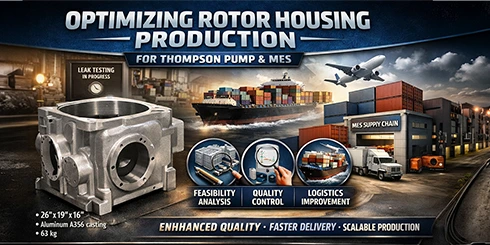
- Documented, repeatable leak-test procedure established
- Drawing/model mismatches resolved before scale-up
- Logistics integrated into consolidated container flow
Most manufacturing inefficiencies remain invisible as long as production continues and parts arrive when expected.
That was the case for Thompson Pump, a manufacturer of hydraulic pumps used across construction, industrial, oil, and gas applications. In one of its systems, performance depends on a large aluminum rotor housing that must consistently perform in demanding environments.
The part had been produced by the same supplier for years, but long lead times and small production runs made it increasingly difficult to get parts when needed.
A demanding part with informal standards
The Thompson 74S8603 rotor housing operates in high-pressure hydraulic environments where leak performance is a safety requirement, not just a functional one. Any porosity, dimensional variation, or sealing issue can compromise performance and introduce risk.
The part itself presents inherent manufacturing challenges:
- Aluminum A356 gravity casting
- Machined and tested after casting
- Approximate dimensions of 26 × 19 × 16 inches
- Weight of roughly 63 kilograms
Formalizing quality before scaling
MES’s review revealed a critical gap: leak performance was expected, but a documented, repeatable leak-testing procedure did not exist. Testing expectations had been applied informally, without a defined standard that could be consistently executed or validated as production needs change.
The documentation review surfaced additional risks — mismatches between 2D drawings and 3D models, dimensions defined in one format but missing in the other, and ambiguity around inspection and acceptance criteria.
Rather than proceeding with incomplete definitions, MES clarified requirements before scale: feature-by-feature dimensional review, laser scanning and dimensional reporting, tooling adjustments for high-risk areas, and weekly collaboration on tooling, quality, and testing requirements.
Reworking the logistics model
The existing setup relied on production runs of 10 to 20 units placed on underutilized containers, with inventory remaining overseas and long lead times accepted as normal.
Because MES manages regular container shipments across multiple customers and suppliers, Thompson’s parts could be integrated into consolidated flows — turning an inefficient, isolated logistics model into part of an optimized system.
Scaling production starts with formalizing what’s been assumed. If a critical part in your lineup runs on informal standards, let’s define them before they become a problem.
Start the Conversation