Why Battery Mounting Details Matter More in Electric Vehicles
- Multiple bracket variants controlled across design, manufacturing, and quality
- Forging, machining, and coating treated as one production system
- Extended salt-spray corrosion targets met without compromising fit
Battery retention hardware has a thankless job. It rarely gets attention in electric vehicle programs because it doesn’t move power, manage heat, or control performance. Yet when batteries are mounted directly inside the chassis, the retention components that secure them become an integral part of the vehicle’s structural system.
Harbinger Motors manufactures medium-duty electric vehicle chassis for commercial applications — walk-in vans, box trucks, and recreational vehicles — designed for long service life under high-demand operating conditions. As Harbinger moved into early production of its first chassis, it partnered with MES to apply production-level discipline to a set of frame-mounted battery securing brackets.
Why these brackets demand chassis-level consideration
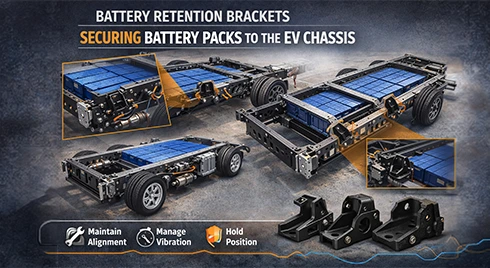
Battery mounting brackets are typically low-complexity parts. But in this application, they function as the mechanical interface between the battery system and the chassis itself. Each bracket must maintain precise alignment under load, manage vibration, and hold position despite moisture, road debris, and corrosive environments.
The brackets were not interchangeable — multiple configurations were required based on mounting location, resulting in several distinct geometries and numerous part numbers. Some variants incorporated secondary features such as cable retention, adding functional requirements that still had to meet dimensional and durability standards.
Forging, machining, and coating as one system
The brackets were forged for strength and durability, then machined to meet alignment and fit requirements. Forging introduced risk beyond basic geometry: variations in material flow and grain structure could lead to internal stress or cracking if not tightly controlled — and once forging is complete, those characteristics cannot be fully corrected through machining.
Because these parts interface directly with the vehicle structure, process sequencing and control were critical across every step. Early process decisions set constraints on corrective options later.
Corrosion protection as a performance requirement
Sitting at the chassis level, the brackets are exposed to road salt, moisture, and debris. Corrosion resistance was a functional requirement, not an appearance consideration.
The coating system had to meet extended salt spray performance targets consistent with snow, ice, and road salt exposure — evaluated not only for corrosion resistance but for its impact on dimensional fit across multiple bracket configurations.
In EV programs, the unglamorous parts carry structural responsibility. If your program treats brackets as commodities, it may be worth a second look — before production locks in the risk.
Start the Conversation