How to Make Nearsourcing Manufacturing in Mexico Work for You

- Landed cost — not unit price — is the number that decides your sourcing strategy
- Mexico wins on landed cost ($8.53 vs. $8.77 China, $9.09 US) in a real-world comparison
- Tooling remains Mexico’s weak point: 3–5x the cost of Asia, with longer lead times
With tariffs followed by COVID, manufacturers are under pressure to keep up production and maintain profitability while containing costs — and to do so in the face of a stunted supply chain. Things are very different now than they were just five years ago.
Sourcing and supply chain professionals are at a crossroads, having to evaluate the options: continue to outsource internationally and risk long lead times and shipping delays? Adopt a nearsourcing strategy even though it may increase tooling costs? Or is there another strategy that captures the benefits of both?
This white paper examines global outsourcing and North American nearsourcing strategies to give U.S.-based manufacturers new insights — and options — for doing manufacturing in Mexico right.
Sourcing has changed
Since the pandemic, it’s become trendy to bring production back to the U.S. from Asia or, at the very least, to keep it in Mexico. Today, sourcing is marked by rising transportation costs, increased tariffs on production in China, and a push to go local. There’s an overall climate of “something’s got to change” with outsourcing.
When demand variance is volatile and transportation costs are high, nearsourcing offers unique cost advantages:
- Inventory cost savings — reduced opportunity, storage, and unsold inventory costs
- Quick response to stock-outs
- Production flexibility and lower machining costs
- Decreased transportation expenses
Where Asia still wins
Outsourcing is not without its own benefits. Production labor runs roughly $5.50/hour in China versus $6 in Mexico and $15 in the U.S. — and the gap widens with specialization: maintenance labor runs $15 / $20 / $45 respectively. Many Asian suppliers can also integrate castings, painting, and machining in-house, keeping overall production costs down.
Tooling is the biggest differentiator. North American tooling costs run roughly 3x to 5x the cost of tooling development in Asia, with lead times of 10–12 weeks versus 6–8 weeks in China. Tooling costs are a major factor in determining both the break-even point and profitability.
A real-world example: landed cost tells the story
Consider an automotive manufacturer whose lineup expanded to two engines, four transmissions, a hybrid, and an EV model — requiring four different tools instead of one. Comparing the true landed cost (production + transit + overage + underage + capital lock) across regions:
- China: $8.77 per part
- US: $9.09 per part
- Mexico: $8.53 per part
Making Mexico work
Looking only at landed cost, Mexico would seem ideal — it has the cost advantage plus nearsourcing’s inherent flexibility. But Mexico lacks one thing in comparison to Asia: cost-effective tooling manufacturing capability.
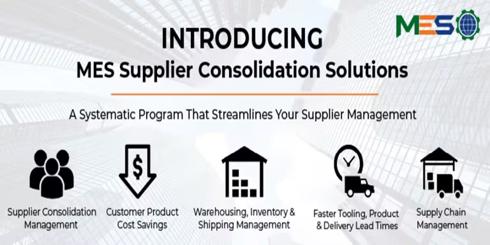
The winning strategy is a hybrid: develop tooling in Asia where it is 3–5x cheaper and faster, then run production in Mexico close to the point of consumption. That is how manufacturers reap the benefits of both worlds — and it is exactly the model MES operates for its customers.
The right sourcing strategy isn’t nearsourcing or outsourcing — it’s knowing which pieces of your program belong where. MES helps manufacturers build hybrid programs that combine Asian tooling economics with North American production flexibility.
Start the Conversation