After Pace: Building a More Resilient Die Casting Supply Chain
The Pace Industries closure and what it signals
Pace Industries has announced the permanent closure of its plants in Harrison, Arkansas; Muskegon, Michigan; and Jackson, Tennessee — withdrawing a substantial volume of aluminum die casting capacity from the North American market. For Pace’s direct customers, the urgency is immediate: tooling has to move, programs have to be requalified, and continuity of supply has to be secured before the closure clock runs out.
But the implications extend well beyond Pace’s customer list. North American die casting capacity has been quietly contracting for years, pressured by energy costs, labor availability, and capital investment requirements. Pace was one of the largest aluminum die casters on the continent. Its exit removes a meaningful share of regional capacity at a moment when surviving suppliers are already running at high utilization.
For procurement leaders, two risks compound: capacity risk as demand redistributes across fewer suppliers, and continuity risk as tooling transfers, requalification, and PPAP cycles consume engineering bandwidth that most organizations are not staffed to absorb on short notice.
The takeaway is not that domestic die casting is finished — it isn’t. The takeaway is that supply chain architecture now matters more than any single supplier relationship. The manufacturers who weather closures like this with the least disruption are the ones whose programs were designed for resilience from the start: globally diversified, redundantly sourced, actively managed, and supported by a partner who owns outcomes rather than just delivers parts.
That is the model MES has been building for years. Here is what it looks like in practice.
A global sourcing network built for resilience
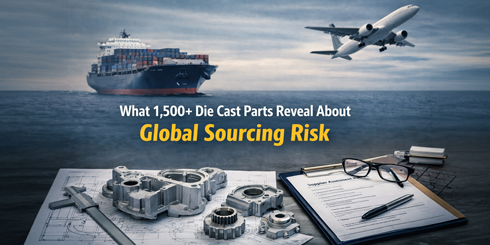
MES is not a single-plant manufacturer. We are a supply chain management partner with active sourcing operations across China, Mexico, India, Vietnam, and Europe — each region selected for specific cost, lead time, capability, and geopolitical risk characteristics. We currently manage more than 1,500 die cast components across this network.
This footprint exists for one reason: when a region experiences disruption — political, logistical, or operational — we can shift volume without disrupting your production schedule. Dual-source redundancy is engineered into every program from day one, not bolted on after the first crisis.
For North American manufacturers in particular, our USMCA-compliant nearshoring in Mexico, paired with U.S. warehouse inventory in Ohio, gives customers the speed and trade compliance of regional supply with the cost structure and capacity of global sourcing.
Full die casting capability — and beyond
Die casting is core to what we do, but it is one capability within a broader manufacturing portfolio that includes forgings, extrusions, CNC machining, and investment castings — all managed under the same program framework, by the same teams, against the same standards. Within die casting specifically, MES delivers:
- High-pressure and low-pressure die casting in aluminum, zinc, magnesium, and brass
- Press range from 50 to 4,400 tons — precision components through large structural castings
- Tolerances to ±0.005″
- Integrated CNC machining, leak testing, X-ray, and ultrasonic inspection
- Moldflow analysis before tooling is cut, so issues are resolved in design — not on your production floor
A dedicated program team for every customer
This is where MES diverges most sharply from the transactional supplier model. Every MES customer is assigned a dedicated supply chain specialist — a single point of accountability who provides live updates from the factory floor through warehousing to your dock — and a dedicated planner who partners directly with your team on forecasting, order management, and demand planning.
When something changes — a forecast shift, a quality concern, a supplier issue — you are not opening a ticket. You are calling people who already know your program inside and out.
On-site engineering and quality at the source
MES engineers and quality professionals are physically present at supplier facilities during production runs. We don’t rely on a quality report emailed from another continent — we manage consistency at the shop floor, on the press, during the run.
In design, our engineers support design-for-manufacturability, tooling design review, and Moldflow analysis before steel is cut. In production, our quality team conducts in-process inspection, first-article validation, and ongoing audits at the supplier facility. At delivery, every program passes through our quality system before reaching your dock.
The result: issues are caught upstream — before they become disruptions, scrap, or line-down events on your floor.
Warehousing, JIT, and post-production support
MES operates warehouses in Ohio, Mexico, and Europe — strategically located to support JIT delivery into customer plants across our key markets. These facilities are more than storage: inventory programs that decouple your production schedule from overseas lead times, rework, kitting, sub-assembly, and packaging for last-mile customization, and buffer inventory that absorbs shipping variability, demand spikes, and supplier slowdowns.
For customers transitioning from a domestic single-source model to a globally diversified one, this regional warehouse footprint is often the missing link that makes global sourcing feel local.
Closing thought
Supplier closures are disruptive, but they are also clarifying. They reveal which supply chains were built for resilience and which were built around the last quote received. The manufacturers who use this moment to rethink their sourcing model — not just replace their supplier — will emerge with stronger, more durable operations.
If your team is reassessing die casting supply in the wake of the Pace closure, we would welcome the conversation.
Start the Conversation