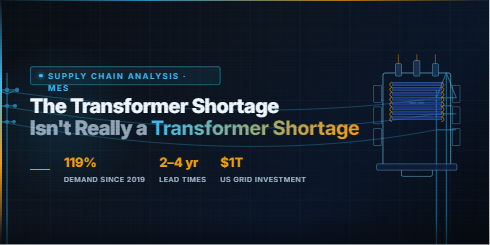
The Transformer Shortage Isn’t Really a Transformer Shortage
Everybody agrees transformers are hard to get.
Power transformer demand in the United States has increased 119% since 2019. Lead times on large power transformers now routinely stretch two to four years. Utilities, data center developers, renewable energy projects, and industrial users are all competing for the same manufacturing capacity.
But the way the industry talks about it may be creating an entirely separate problem.
“Transformer shortage” has become a catch-all phrase that obscures what’s happening inside the supply chain. A transformer isn’t one thing. It’s a collection of electrical, mechanical, thermal, structural, and safety systems that happen to ship together. Yet the industry increasingly treats every component as though it suffers from the same constraints, regardless of where it sits in the bill of materials.
It doesn’t. And that distinction is the difference between a component constraint and a program-wide one.
The perfect storm behind today’s demand
The current shortage didn’t get here by accident. It’s the result of several long-term trends colliding at once: grid infrastructure deferred too long, data center construction accelerating power demand faster than anyone modeled, electrification from EVs and heat pumps arriving at distribution grids that weren’t built for it, and a renewable interconnection queue that outgrew available capacity.
The average U.S. transformer is more than 33 years old. Approximately 40 million distribution units have exceeded their useful life. The global power transformer market stood at $23.2 billion in 2025 and is projected to reach $33 billion by 2034 — and the U.S. alone is expected to invest roughly $1 trillion in grid infrastructure over the next decade.
The demand is real. It’s the bottleneck that’s misunderstood.
The industry has correctly identified the constraint
The longest lead times are concentrated in a handful of highly specific components:
- Cold-rolled grain-oriented (CRGO) electrical steel laminations
- Copper and aluminum windings
- Specialty magnetic assemblies that form the transformer core
These are true constraints. They require dedicated production capacity, deep manufacturing expertise, and long qualification cycles. They deserve the attention they’re getting.
The industry is not wrong about where the problem lives. But it may be wrong about how far the constraint reaches.
When one bottleneck starts controlling everything
Once a major constraint is identified, it starts to influence everything. Schedules get built around it, procurement priorities shift, and eventually the bottleneck begins shaping decisions far beyond the components it affects.
CRGO steel and winding capacity may determine the critical path, yet they don’t determine every component required to build a transformer. Still, many organizations behave as though they do. Activities that could be moving forward independently end up waiting for the bottleneck to clear first — not because they have to, but because that’s how the workflow evolved.
A transformer has two very different supply chains
First, there’s the electrical side: CRGO laminations, copper and aluminum windings, magnetic assemblies, and OEM-controlled electrical systems.
Then there’s the mechanical side: tank bodies and covers, conservator tanks, cooling radiator assemblies, terminal connectors and lugs, mounting brackets and base hardware, OLTC enclosures, oil valves and fittings, pressure relief device housings, bushing flanges and mounting hardware.
These components move through entirely different manufacturing ecosystems — casting, machining, fabrication, and global sourcing networks — each with different suppliers, production methods, and constraints. Yet they’re frequently managed as though they belong to the same bottleneck as the core.
The hidden cost of waiting
The most expensive delay in a transformer program isn’t necessarily the one everyone is talking about.
When mechanical hardware, supplier qualification, and tooling are forced to wait on constraints that don’t actually apply to them, the bottleneck expands beyond its actual boundaries — and additional schedule risk gets layered on top of an already difficult market.
A different question for sourcing teams
What would happen if instead of asking, “How do we reduce transformer lead times?” teams asked, “Which parts of the transformer are responsible for the lead time?”
The first question assumes the entire product is constrained. The second recognizes that only portions of the bill of materials are. Suppliers can be qualified earlier, mechanical content can be sourced in parallel, and the project can better absorb some of the industry’s unavoidable delays rather than stacking new ones on top of them.
The decade ahead will reward different thinking
Transformer demand is unlikely to normalize anytime soon. The forces driving grid investment are structural, not cyclical. Data centers will continue their expansion. Utilities will move forward with replacing legacy infrastructure. Electrification will continue adding load.
Not every part of the transformer is constrained in the same way. The sourcing teams that recognize the distinction — and build procurement strategies around it — tend to find more schedule flexibility than the current market narrative suggests.
At MES, this is exactly the work we do. We work with transformer OEMs and sourcing teams that are trying to separate capacity constraints from assumptions. In many cases, that starts with a simple exercise: mapping which component families are gated by the electrical core, and which can be sourced, qualified, and staged independently.
If your team is building transformer programs around multi-year lead times, let’s map which parts of your bill of materials actually need to wait — and which don’t.
Start the Conversation