The gap nobody puts on the roadmap
Most robotics companies move quickly in early-stage manufacturing. Prototypes come together fast. Designs are iterated in real time. Functional units reach customers in months, not years — letting teams validate performance, gather data, and refine the system in the field.
During this phase, many robot components are produced using flexible methods that prioritize speed over long-term manufacturability. Here, speed is an advantage, and the process works.
At some point — usually sooner than expected — the work shifts from “Does this robot work?” to “Can we build enough of them, reliably, at a cost that makes the business viable?” A different question demands a different way of thinking.
Scaling is a different problem than building
Going from a pilot run of 50 units to a first production batch of 1,000 is challenging. Going from 1,000 to 50,000 is a new level of complexity.
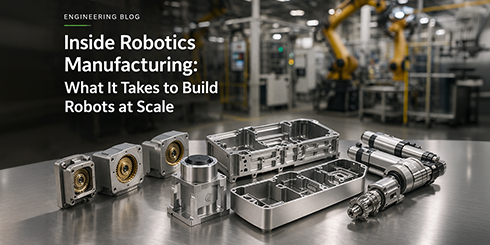
At that scale, the constraints aren’t technical in the traditional sense. The robot works, the software is solid, the mechanical design is validated. Yet suddenly, things that weren’t a problem become critical — especially in the transition from billet machining to processes like aluminum die casting and precision CNC machining.
Parts that performed perfectly when machined from billet don’t translate cleanly to casting. Tooling lead times that looked manageable stretch to three to five months. Suppliers that handled the pilot run don’t have the capacity or process discipline to support a production ramp. Lead times creep, then expand — and soon the supply chain is driving the business instead of enabling it.
Where design and manufacturing disconnect
Look closely at most scaling failures and a clear pattern emerges: the product was never fully designed with high-volume manufacturing in mind. In early development that’s the right tradeoff — speed matters more than optimization. But carrying the development mindset too far into production creates problems that are expensive to fix under pressure:
- Components that require excessive secondary machining because casting geometry was never optimized
- Designs that introduce porosity or distortion in high-pressure die casting because the DFM review happened too late
- Tolerance stack-ups across cast and machined features that only reveal themselves in full assemblies at volume
- Tooling that must be reworked or rebuilt mid-ramp, costing both time and capital
Supply chain decisions have a shelf life
Manufacturing and supply chain decisions tend to be treated as execution work — things to sort out after the product design is stable. The problem is that by the time the design is finalized, most of the important supply chain constraints have already been baked in: where a part can be produced, how it flows through machining and assembly, whether it can be sourced from multiple regions, and how easily capacity can expand as volumes grow.
When these decisions are deferred, companies often end up concentrated in a single geography with no backup when disruption hits, exposed to tariff shifts, and locked into lead times and minimum order quantities that make it hard to respond to demand. None of this is intentional — it’s the result of treating supply chain as a procurement exercise rather than a strategic one.
The electric vehicle industry went through the same transition on a compressed timeline. The robotics companies that scale smoothly will be the ones that bring manufacturing thinking into the design phase — not after it.
If your robotics program is approaching the transition from prototype to production volume, we’d welcome a conversation about designing for scale before the constraints set in.
Start the Conversation