What Every Operations Team Should Understand About Lead Time
Lead time is one of those terms everyone in manufacturing uses, and almost everyone defines differently.
Ask the production manager, and the answer is, “How long does it take to make a part?” Ask the logistics coordinator, and the answer is “Transit time.” Ask the procurement team, and they start counting from the moment a purchase order goes out.
All of them are right. All of them are also incomplete.
Lead time is the total elapsed time from when an order is placed to when finished goods are in hand. Every step in between — production, inspection, packaging, shipping — is part of that clock. When a team is only measuring one piece, they don’t really know their true lead time.
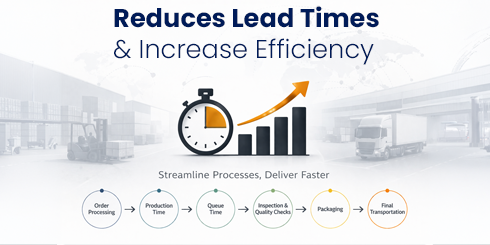
What lead time includes
A complete lead time covers the full process from end to end:
- Order processing — reviewing specs, confirming quantities, releasing the order into production
- Production time — setup, machining, finishing, and assembly
- Queue time — waiting between operations while other jobs move ahead
- Inspection and quality checks — validating parts against spec before they move forward
- Packaging and handling — preparing parts for shipment
- Transportation — moving goods from supplier to final destination
Where time goes
Most lead time problems don’t come from one big delay. They build up slowly, across stages, in ways that are easy to miss: incomplete order information that stalls the release, scheduling gaps between production steps, inspection cycles that take longer than expected, inefficient packaging or handling, and transit delays — especially across international routes.
None of these are catastrophic on their own. But combined, they can add days or weeks to the timeline before anyone thinks to question it. When delays are spread across stages, they become invisible — and when lead time becomes a given, the number gets baked into planning assumptions, safety stock calculations, and customer commitments, and nobody challenges it.
Why lead time shapes the whole operation
Lead time doesn’t just affect shipping dates. Longer lead times mean more stock on hand — more working capital tied up in parts sitting idle. Inconsistent lead times make reliable production scheduling nearly impossible. Long lead times lock teams into decisions made weeks or months in advance. And lead time variability creates rescheduling, expediting, and coordination overhead — all of which cost time and money.
How companies actually reduce lead time
Improving lead time rarely requires a dramatic overhaul. More often, it’s about finding where time is being added unnecessarily and making targeted changes:
- Clean up the order process — better upfront accuracy is one of the easiest wins available
- Reduce queue time — where jobs sit waiting usually reveals a scheduling problem or capacity imbalance
- Streamline inspections — align quality checks with production flow instead of interrupting it
- Review logistics — rethink carrier choices, routes, or even supplier locations
- Improve communication — coordination gaps quietly add days to timelines
Lead time vs. lead time variability
A supplier with a consistent 10-week lead time is easier to plan around than one whose lead times swing between 5 and 14 weeks. Predictability matters as much as speed.
When lead times are consistent, manufacturers can plan production more accurately, carry less safety stock, make reliable commitments to customers, and reduce last-minute firefighting. For many organizations, reducing variability delivers more operational value than reducing average lead time.
The bottom line
Lead time is a window into how a resilient supply chain operates. When it’s treated as a fixed constraint, the whole operation gets designed around absorbing it. When it’s broken down and examined, there’s almost always room to improve.
For manufacturers sourcing across multiple suppliers and regions, that visibility isn’t just helpful. It’s the foundation for running a more consistent, more responsive operation.
MES works with manufacturers to evaluate sourcing, production, and logistics strategies — and to build the visibility needed to manage lead time across global supply chains. Let’s talk about where your time is going.
Start the Conversation