Inside Robotics Manufacturing: What It Takes to Build Robots at Scale
Read enough about robotics and the language quickly centers on software: foundation models, embodied intelligence, sim-to-real transfer. The technology is advancing quickly, so much of the focus has been on what robots can do.
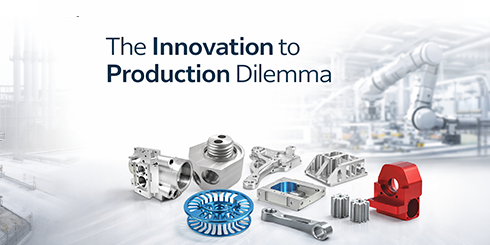
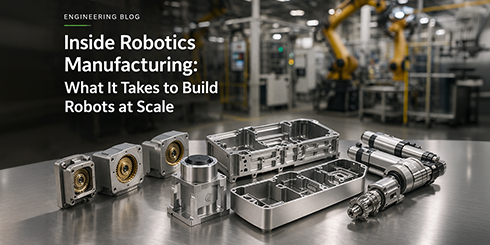
What goes unnoticed is how those capabilities are realized. Behind every robot is a system of mechanical components that must perform under load, manage heat, maintain tight tolerances, and operate reliably over millions of cycles. Robotics manufacturing depends on the ability to produce precision components and structural parts at scale.
The components behind every robot
A single humanoid or mobile robot contains dozens of structural components, each designed for a specific mechanical function:
- Structural frames and chassis that define stiffness, weight distribution, and how all other systems connect — typically aluminum extrusion, casting, or hybrid structures
- Actuator and joint housings that manage dynamic loads and maintain alignment under constant cyclic stress
- Gearbox and harmonic drive housings that demand tight tolerances and consistent geometry — usually die cast, then precision CNC machined
- Motor enclosures that must maintain alignment while managing heat
- Battery and electronics housings that protect sensitive systems while serving as load-bearing elements
What changes at scale
At low volumes, many of these components can be machined from billet, giving engineering teams flexibility to iterate quickly. As volumes climb into the tens or hundreds of thousands, production must shift to processes that support scale, consistency, and cost efficiency. That transition introduces constraints that must be addressed early:
- Porosity control in aluminum die casting for components under repeated loading
- Thin-wall design tradeoffs between weight reduction and structural performance
- Tolerance stack-up across cast and machined features in complex assemblies
- Tooling lead times and capital investment required for high-volume production
- Material and process selection that balances performance with manufacturability
Hardware cannot scale like software
Software can scale quickly. Hardware cannot. Robotics manufacturing depends on access to die casting and forging capacity, precision CNC machining for critical interfaces, consistent quality across multiple suppliers and regions, and supply chain structures that can grow without disruption.
Each of those elements — foundries, machining centers, tooling, qualified suppliers — takes time to develop, validate, and scale. As volumes increase, these manufacturing and supply chain constraints become the defining factors in how quickly a robotics company can grow.
No robot component is designed or manufactured in isolation. The companies that treat their components as part of a scalable manufacturing system — rather than a collection of individual parts — are the ones that ramp successfully.
If you’re building robots and planning the jump to production volume, we’d welcome a conversation about the manufacturing system behind your components.
Start the Conversation