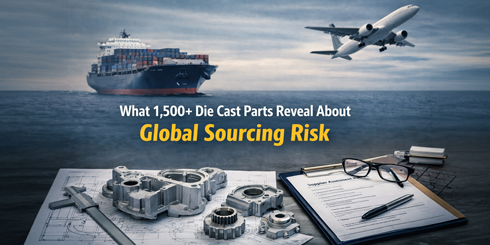
What 1,500+ Die Cast Parts Reveal About Global Sourcing Risk
Over the past 15 years, MES has developed more than 1,500 aluminum die cast components across automotive, lighting, industrial, electrical, and hydraulic applications.
That experience reveals a critical insight: most die casting sourcing failures are not caused by cost — but by poor execution across tooling, supplier selection, and global coordination.
The illusion of simplicity in die casting
Aluminum die casting is often perceived as a mature, commoditized process. It is not. Each component introduces complexity across tool design and thermal dynamics, metal flow and porosity control, machining tolerances and datum stability, and surface finishing and cosmetic standards.
The challenge is not making a part — it is making it repeatedly, globally, and at scale.
Where die casting programs actually fail
Across hundreds of programs, the failure points are remarkably consistent:
- Supplier mismatch — sourcing decisions that prioritize cost over capability alignment, leading to delays in tooling and validation and quality issues that emerge post-launch
- Tooling & PPAP execution — tool longevity and consistency, PPAP documentation across regions, and first-pass yield stability challenge even experienced suppliers
- Lack of supply chain redundancy — single-region sourcing creates geopolitical exposure, logistics volatility, and limited recovery options
The common thread: execution — not pricing.
What 1,500+ developed parts actually teach
MES’s dataset of 1,558 parts reveals clear patterns:
- The majority of demand sits in the 100–400 ton press range
- Mid-complexity parts drive the highest volume — and the highest risk
- High-tonnage parts require specialized supplier selection
- Multi-country sourcing is not optional — it is necessary
The shift to multi-region sourcing
Global sourcing is no longer about choosing a country. It is about designing a system.
China brings a mature ecosystem, speed, scale, and tooling expertise. India offers a cost advantage and expanding engineering capabilities. Mexico delivers nearshoring benefits, reduced lead times, and integration with U.S. operations. Vietnam adds strategic diversification and an emerging supplier base.
The future is not China vs. India. It is China + India + Mexico + Vietnam — strategically deployed.
From supplier to system: the MES approach
Most companies operate in a transactional sourcing model. MES operates as an integrated system: a global supplier network across regions, centralized quality and PPAP management, end-to-end supply chain ownership, warehousing and post-processing capabilities, and tooling built for multiple suppliers and countries.
This approach transforms sourcing from reactive to proactive, from fragmented to integrated, from cost-focused to risk-optimized.
What this means for OEMs and tier suppliers
- Speed to market — faster launches through experienced execution
- Quality stability — fewer surprises during production ramp-up
- Total cost reduction — lower total cost, not just piece price
- Supply chain resilience — the ability to shift and adapt across regions
Conclusion
Developing 1,500+ die cast components is not just a milestone. It is a foundation of experience that enables better decisions.
In today’s environment, the competitive advantage is not who can source cheaper — but who can execute better.
Request a die casting sourcing assessment — we’ll evaluate your component and provide a risk analysis, a recommended sourcing strategy, cost vs. complexity tradeoffs, and timeline insights.
Start the Conversation